Ogun State has, for decades, functioned as a pressure valve for Lagos. As Lagos's population has grown, it is one of the most populous cities in Africa, the cost of land and housing has pushed lower- and middle-income residents outward into adjacent areas. Communities like Mowe, Ibafo, Sagamu, and Akute, which were relatively small towns a generation ago, have grown into substantial urban settlements populated largely by people who commute to Lagos but can no longer afford to live there.
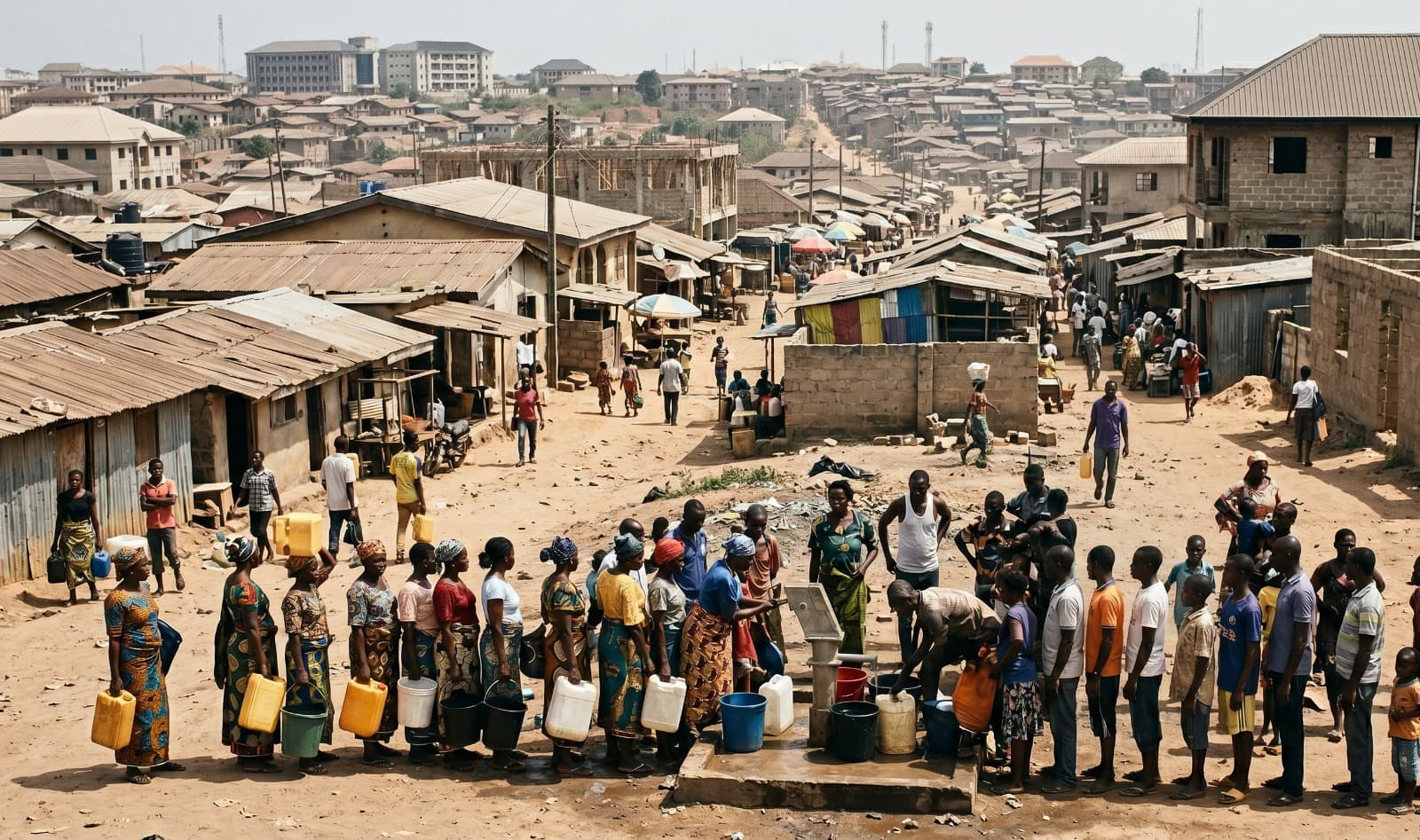
This growth has mostly occurred without the accompanying expansion of water and sanitation infrastructure. Water networks were designed for much smaller populations. The Lagos State boundary offers no protection from this spillover, water utility service areas do not expand automatically when people move into them. Residents of newer estates and informal settlements on the urban fringe frequently find that the pipe network does not reach their street, or that where pipes technically exist, pressure is too low to be useful.
The challenge is not simply one of volume, more people needing more water. It is also one of geography and formality. The people who most need infrastructure improvements are often living in the newest, least formalised parts of the city, where land tenure is unclear, streets are unmapped, and utility service is hardest to plan and bill for using conventional approaches.
Standard utility expansion logic, extend the network from the centre outward, does not apply cleanly to informal and peri-urban growth. The settlements are often ahead of the network, not behind it. By the time the pipe arrives, the population has already built coping strategies: vendors, communal boreholes, storage tanks. Those coping strategies are expensive relative to what a functional utility should cost. The urban periphery, already economically marginal, ends up paying a premium for worse service.